April 5, 2026
Article
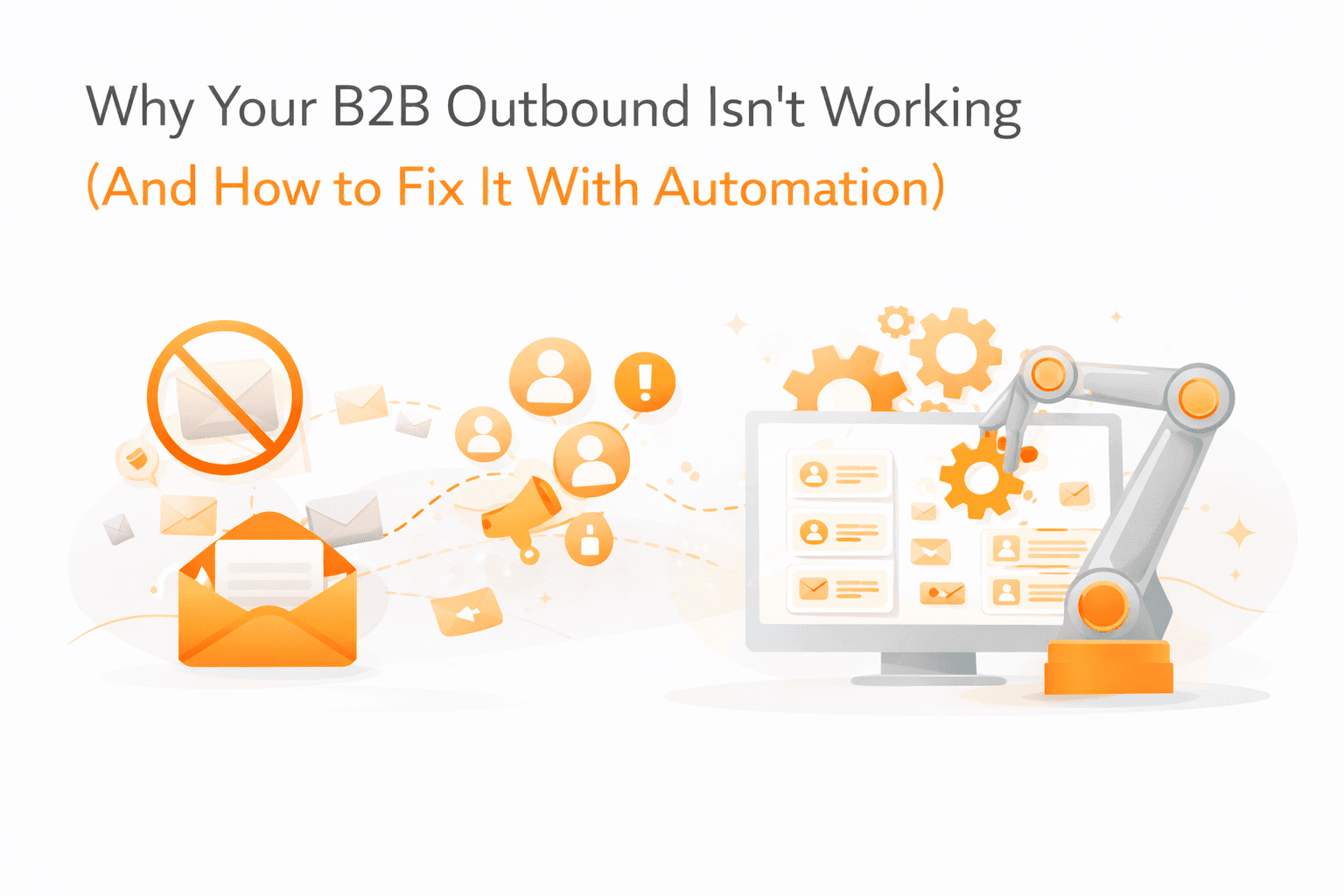
Why Your B2B Outbound Isn't Working (And How to Fix It With Automation)
You've sent hundreds of cold emails. The results? Barely a reply. Cold outbound isn't dead — your system is just broken. Here are the five reasons B2B outbound fails, and exactly how to fix each one.
Reason 1: You're Targeting the Wrong People
This is the most common and most expensive mistake in outbound. Founders build a list of companies in a vague industry category, find whoever's email they can scrape, and send the same message to all of them. The result: low open rates, lower reply rates, and a growing suspicion that cold email is dead. Cold email isn't dead — the list is just wrong.
Define your ICP with precision that feels almost uncomfortable. Not just "SaaS companies" but "B2B SaaS companies with 10–50 employees, Series A funded in the last 18 months, selling to enterprise, with a sales team of 3–8 people." Not just "the founder" but "the CEO or Head of Growth who owns revenue and is frustrated that their pipeline is unpredictable." Then use Apollo.io and Clay to build a list matching this profile exactly — filtering by funding stage, headcount, tech stack, and recent hiring activity.
Set up a daily lead ingestion workflow using Apollo + Clay + n8n. Every day, new leads matching your ICP are automatically added to your list, enriched with contact data, scored for fit, and pushed to your outreach sequence. Your pipeline fills itself while you focus on closing.
Reason 2: Your Message Is About You, Not Them
Open your last cold email. Count how many times you used the words "we," "our," and "I." Now count how many times you referenced something specific about them. Most cold emails read like a company brochure — they lead with credentials, list services, and end with "let me know if you'd like to chat." The fundamental rule of outbound: nobody cares about you until they believe you understand them.
The highest-converting cold emails follow a simple structure. Open with a specific, researched observation — not "I came across your profile" but something like "Saw that your company just raised Series A and hired three enterprise AEs last month." Follow with the problem that creates: "Most teams at your stage hit the same wall — the outbound motion that worked at 10 people breaks down at 30." Add one-line value prop: "We help B2B teams build automated outbound systems that book 15–20 qualified calls per month without the founder being the bottleneck." End with a single CTA: "Worth a 15-minute call this week?"
Total length: under 100 words. No attachments. No links — they kill deliverability. No case studies in the first email. Use Clay to pull dynamic personalisation variables at scale — recent LinkedIn posts, company news, funding announcements — and inject them automatically into your templates.
Reason 3: You're Only Sending One Email
Here's a fact most founders don't want to accept: the majority of outbound replies come from follow-up emails, not the first one. Studies consistently show that over 80% of replies in a cold sequence come after the second touchpoint. Yet most founders send one email, wait a week, and when there's no reply, assume the prospect isn't interested. They weren't uninterested — they were just busy.
A high-performing outbound sequence has 5–7 touchpoints spread over 3–4 weeks. Email one on day one: short, personalised, problem-focused, under 100 words. Email two on day four: a different angle, add a specific insight relevant to them. Email three on day eight: social proof without being braggy — "We helped a similar SaaS team go from 3 to 18 qualified calls per month in 60 days." Email four on day fourteen: make it easy to say yes or no — "Is this something you're actively focused on right now, or not a priority?" Email five on day twenty-one: the breakup — "I'll stop following up after this, but wanted to leave the door open."
Add LinkedIn touchpoints between emails — connect after email one, engage with their content genuinely, send a brief DM after email three. Multi-channel outreach significantly lifts reply rates. Sequences in Apollo or Instantly run automatically once a prospect is enrolled — you write the emails once, the tool handles timing and follow-up.
Reason 4: Your Deliverability Is Broken
You can have the best targeting, message, and sequence in the world — and still get zero replies if your emails land in spam. Email deliverability has become significantly harder in 2024–2025. Google and Microsoft have tightened spam filters. Sending too much, too fast, from a new domain is a guaranteed path to the spam folder.
Signs your deliverability is broken: open rates below 20%, high bounce rates, no replies even to personalised messages, or prospects telling you they never got your email.
Fix it with proper infrastructure before sending a single cold email. Use a separate sending domain — never cold email from your main domain. If it gets flagged, your main domain is protected. Warm up your domain using Instantly or Mailreach, gradually increasing from 10 emails per day to 50 over 3–4 weeks. Set up SPF, DKIM, and DMARC records in your DNS — these verify your emails as legitimate and are non-negotiable for deliverability. Keep sending volume at 40–50 emails per day per inbox. And clean your list with NeverBounce or ZeroBounce before sending — a bounce rate above 3% damages your sender reputation fast.
Reason 5: You Have No System — Just Activity
Most founders treat outbound as a task, not a system. They send a batch of emails when they have time. They follow up when they remember. They track results in a spreadsheet they update monthly, if at all. Inconsistent outreach produces inconsistent results — which most founders interpret as "outbound doesn't work," when the real issue is that their outbound never ran long enough or consistently enough to produce data.
Build your outbound as an operating system. Daily: automated sequences running, new leads enriched and enrolled, replies handled. Weekly: review open rates, reply rates, and meeting bookings — identify which email in the sequence is underperforming and A/B test one variable. Monthly: refresh the lead list, update sequences based on what's working, review your ICP definition. Quarterly: full pipeline review — cost per meeting, cost per close, which ICP segment converts fastest — then double down there.
What to Expect When You Fix It
A properly built outbound system targeting the right ICP, with the right message, running consistently, should produce open rates of 40–60%, reply rates of 8–15%, positive reply rates of 3–6%, and meeting booking rates of 1–3% of total emails sent.
At 50 emails per day, that's 1,500 emails per month. At a 2% meeting booking rate, that's 30 qualified meetings per month. At a 20% close rate, that's 6 new clients every month. The math works — the system just needs to be built correctly.
If your outbound is underperforming, don't send more emails. Rebuild your ICP, rebuild your list, rewrite your sequences, fix your deliverability infrastructure, and set up automation so the system runs daily without you. Each change alone improves results. Together, they transform outbound from a frustrating activity into a predictable growth engine.
Need help building your outbound system from scratch? Book a clarity call with Luma Growth Lab — we'll audit your current setup and build the system that actually fills your pipeline.