April 7, 2026
Article
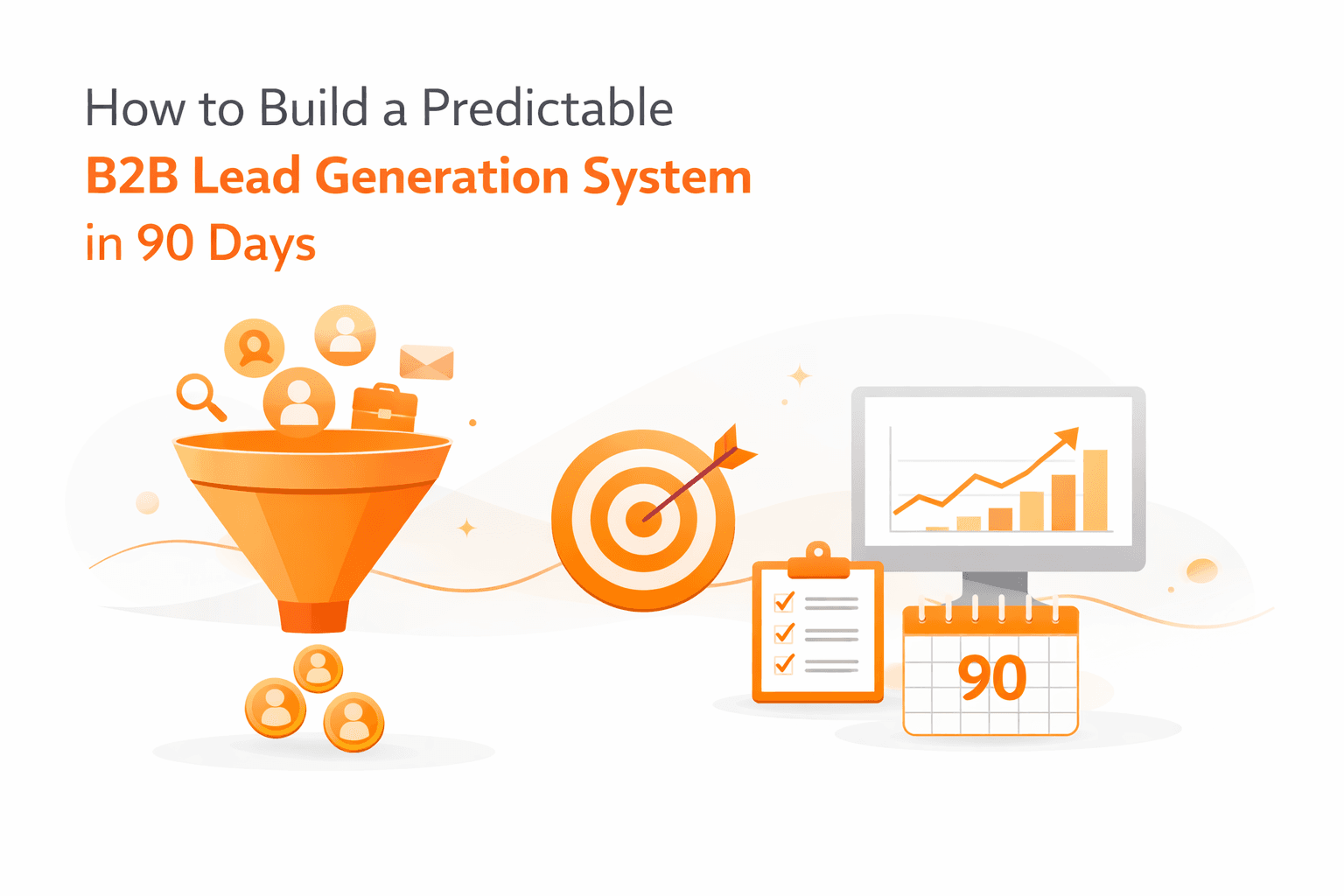
How to Build a Predictable B2B Lead Generation System in 90 Days
Most B2B founders don't have a lead generation problem. They have a system problem. Here's exactly how to build a repeatable, measurable, scalable lead gen engine in 90 days.
Why Most B2B Lead Generation Fails
Most founders try one or two channels at a time — cold email this month, LinkedIn content next month, Google Ads after that. Nothing gets enough runway to compound. Nothing gets measured properly. And when results don't show up in 30 days, the channel gets abandoned.
The other failure mode is over-relying on referrals. Referrals are great — but they're unpredictable by nature. You can't build a growth plan on something you can't control.
A real lead generation system has three properties: it's repeatable (runs on process, not inspiration), measurable (you know exactly what's working), and scalable (when something works, you can do more of it).
Days 1–30: Diagnose and Define
Get crystal clear on your ICP before you build anything. Define with surgical precision: which industry, what company size, which role feels the pain most, and what trigger events make them ready to buy. The more specific your ICP, the more effective every channel becomes.
Then audit your current lead sources. Map every client you've won in the last 12 months — how they found you, the first touchpoint, the sales cycle length, the deal size. This tells you which channel to double down on first rather than guessing.
Finally, set your 90-day pipeline target by working backwards from revenue. If your average deal is ₹2L/month and you want to add ₹10L MRR, you need 5 new clients. At a 20% close rate, that's 25 qualified conversations. At 10% outreach-to-conversation rate, that's 250 targeted touches per month. This math tells you exactly what volume you need.
Days 31–60: Build the Outbound Engine
Stop buying generic lead lists. Build targeted lists using Apollo.io and Clay — filter by industry, company size, tech stack, funding stage, and recent hiring activity. A list of 500 hyper-targeted leads will always outperform a list of 5,000 generic ones.
For cold email, the formula that works: open with a specific observation about them, follow with the problem this creates, add one sentence on how you solve it, end with one simple ask. Keep it under 100 words. No attachments. No case studies in the first email.
Build a 5-step sequence — initial email plus four follow-ups spaced over 3 weeks. Most replies come from follow-up 3 or 4. Then automate it: Apollo or Instantly for sequencing, Clay for personalisation at scale, n8n to connect your tools, and a CRM to track everything.
Days 61–90: Build the Inbound Engine
Outbound gets you meetings now. Inbound builds the pipeline that pays you 6–12 months from now.
For SEO, don't try to rank for everything. As a new domain, focus on 3–5 low-competition, high-intent keywords your ICP actually searches. Create one deeply useful piece of content for each — longer than competitors, more specific, with real frameworks not generic advice.
For AEO, structure your content so it surfaces in ChatGPT, Perplexity, and Google's AI Overviews. Lead with direct answers, use clear headings, write in plain language. For LinkedIn, post once a week with a specific insight or framework — not to go viral, but to stay top-of-mind with the 50–100 people in your network who could hire or refer you.
The System View
Here's what the full system looks like when running: Daily — automated outbound sequences running to new leads. Weekly — one LinkedIn post, pipeline review, one blog post in progress. Monthly — new lead list built, sequences refreshed, SEO rankings checked, content published.
When this runs, you stop wondering where the next lead is coming from. You know what's in the pipeline, what's converting, and what needs adjusting.
What Most Founders Get Wrong
They try to do everything at once — pick outbound or inbound first and get one working before adding the other. They don't give channels enough time — SEO takes 3–6 months, cold email takes 6–8 weeks to optimise, and most founders quit before results arrive. They don't measure — if you don't know your reply rate, meeting-to-close rate, and cost per lead, you're flying blind. And they keep the system in their head — document everything, because a system that lives in your head disappears the moment you get distracted.
The 90-Day Outcome
If you execute this properly, by day 90 you'll have a defined ICP with a live list of 500+ targeted prospects, an automated outbound sequence running daily, at least 3 SEO-optimised pieces of content published, a LinkedIn content rhythm building authority, and a pipeline you can actually predict.
That's the difference between a business that grows by accident and one that grows by design.
Ready to build your growth system? Book a free clarity call with Luma Growth Lab — we'll diagnose your current setup and show you exactly where the gaps are.